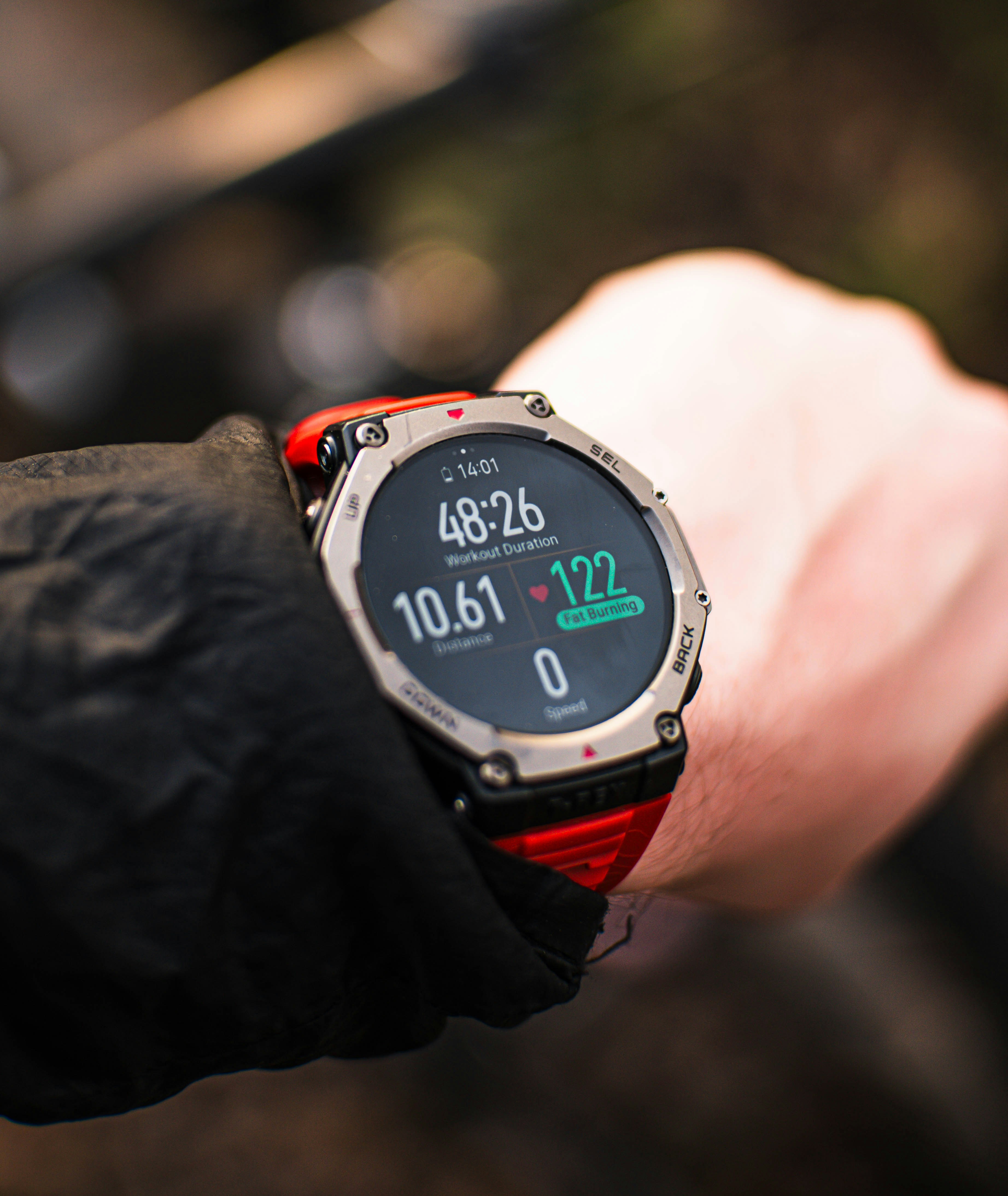
Every heart rate training zone you've ever calculated depends on one number: your maximum heart rate. Get it wrong and every zone shifts — easy runs become tempo runs, recovery runs become easy runs, and the entire system that's supposed to prevent overtraining does the opposite.
The problem? Most runners use 220 − age, a formula published in 1971 that was never intended as a clinical tool. Its standard deviation is ±10–12 BPM. For a 35-year-old, that means a "predicted" max HR of 185 could actually be anywhere from 173 to 197.
That's a 24-beat range. Your entire zone system lives inside that margin of error.
Why Max HR Matters
Maximum heart rate (HRmax) is the highest number of beats per minute your heart can achieve during all-out exertion. It's genetically determined and does not improve with training — a common misconception. What training changes is your resting heart rate, stroke volume, and the proportion of HRmax you can sustain.
HRmax sets the ceiling for every heart-rate-based training model:
- The Karvonen method uses it to calculate Heart Rate Reserve (HRR = HRmax − Resting HR)
- %HRmax zones use it directly as the reference point
- Cardiac drift monitoring tracks how close you are to HRmax during steady-state efforts
If your HRmax is off by 10 beats, every zone boundary shifts by 5–8 BPM — enough to turn an easy run into a tempo run.
Method 1: The 220 − Age Formula
Accuracy: ±10–12 BPM (standard deviation)
This formula comes from a 1971 paper by Fox, Naughton, and Haskell. It was derived from a literature review of 11 studies — not a controlled experiment. The subjects were predominantly sedentary men. It has never been validated as accurate for trained athletes, women, or older adults.
When to use it: As a starting point when you cannot perform any field test (e.g., medical restrictions). Understand that your actual HRmax could be 10+ beats higher or lower.
Method 2: The Tanaka Formula
Accuracy: ±7–8 BPM (standard deviation)
Published in 2001 by Tanaka, Monahan, and Seals after a meta-analysis of 351 studies involving 18,712 subjects. It's more accurate than 220 − age across all age groups, particularly for older adults. For a 35-year-old, it predicts 183.5 vs. 185 — a small difference at younger ages, but the gap widens after 40.
When to use it: A better estimate than 220 − age, but still a population average. Use it when a field test isn't feasible.
Method 3: The 3-Minute Hill Test
This is the most practical field test for recreational runners. It requires a steep hill (6–8% gradient) and a heart rate monitor with a chest strap (wrist sensors lag too much at high intensities).
Protocol:
- Warm up for 10–15 minutes at easy pace, including 4 × 20-second strides
- Run hard uphill for 3 minutes at the fastest pace you can sustain for that period — this should feel like a 9/10 effort
- Jog slowly back down for 3 minutes
- Repeat the 3-minute hard uphill effort — push even harder in the final 60 seconds
- Record the peak HR from the second effort
Why it works: The first effort pre-loads your cardiovascular system. The second effort, pushed to maximum in the final minute, consistently produces readings within 2–3 BPM of true HRmax in lab testing.
Accuracy: ±2–3 BPM when performed correctly
Caution: This is an all-out effort. Do not attempt if you have any cardiovascular concerns, are new to running (less than 6 months of consistent training), or have not been cleared for maximal exercise by a doctor.
Method 4: The 5 × 1-Minute Ramp Test
A more structured alternative to the hill test, designed to elicit a true maximal response.
Protocol:
- Warm up for 15 minutes with strides
- On flat ground or a track, run 5 × 1-minute intervals with 1-minute recovery jogs:
- Interval 1: Moderate effort (6/10)
- Interval 2: Hard effort (7/10)
- Interval 3: Very hard (8/10)
- Interval 4: Near-maximal (9/10)
- Interval 5: All-out sprint for the final 30 seconds (10/10)
- Record the peak HR from interval 5
Why it works: The progressive ramp prevents premature fatigue while driving HR to its ceiling in the final burst. The 1-minute recoveries are too short to fully recover, so each interval starts from a higher baseline.
Accuracy: ±2–4 BPM
Method 5: Lab Graded Exercise Test (GXT)
The gold standard. A sports physiology lab runs you on a treadmill with incrementally increasing speed and/or gradient every 1–2 minutes until volitional exhaustion. Continuous ECG monitoring records the exact peak HR. Many labs also measure VO₂max simultaneously.
Accuracy: ±1 BPM (the reference standard)
Cost: £50–150 / $80–200 depending on location. University sports science departments often offer discounted tests.
When to use it: If you're serious about heart rate training, planning for a specific time goal, or want VO₂max data alongside HRmax. One test gives you definitive numbers for years — HRmax doesn't change significantly with training.
Common Mistakes
Using wrist-based HR for max testing
Optical wrist sensors lag 5–15 seconds during rapid HR changes and frequently misread at high intensities. Use a chest strap for any max HR test.
Not going truly all-out
A "hard" effort that feels uncomfortable is not the same as maximal. If you could speak a sentence during the final interval, you didn't reach HRmax. The last 30 seconds should feel desperate.
Testing when fatigued
Max HR tests should be performed when fresh — not after a long run, a hard week, or on inadequate sleep. Fatigue suppresses HRmax by 3–8 beats.
Assuming max HR changes with fitness
It doesn't. What changes is your resting HR and the fraction of HRmax you can sustain. If you tested 195 two years ago and have trained consistently, your HRmax is still ~195.
Using a single reading
If your test produced 188 but you've seen 191 on a race finish, your HRmax is at least 191. Always use the highest reliable reading you've ever recorded.
Which Method Should You Use?
| Situation | Recommended Method |
|---|---|
| Cannot exercise maximally (medical) | Tanaka formula (208 − 0.7 × age) |
| Recreational runner, no hill access | 5 × 1-minute ramp test |
| Recreational runner with hills nearby | 3-minute hill test |
| Competitive runner wanting precision | 3-minute hill test + validate in races |
| Serious athlete / time-goal focused | Lab GXT |
Once you have a reliable HRmax, plug it into the Heart Rate Zone Calculator along with your resting HR to get personalised Karvonen zones.
Summary
- 220 − age is a rough population average with ±12 BPM error — use it only as a fallback
- 208 − 0.7 × age (Tanaka) is more accurate but still an estimate
- The 3-minute hill test is the best practical field test for most runners
- Always use a chest strap for max HR testing — wrist sensors are unreliable at high intensities
- HRmax is genetic and does not change with training — one good test lasts for years
- Use the highest reliable reading you've ever recorded, not just a single test result